Wednesday, March 13, 2013

Tuesday, March 12, 2013
Media Specificity


ARTIST STATEMENT:
I wanted to focus on Literature and specifically within
literature I wanted to focus on the aspect of the medium that deals with
sentence structure and words. No other medium uses the written language with
such a force as literature. No other medium is so dependent upon the
formulations and organization of words as literature is.
My idea was to take a couple pages of an already established
piece of literature and rewrite a new story within the book by rearranging the
words and crossing out some of the text. I often find that when I am reading,
sometimes I miss a word a two or even a whole page and the story changes
dramatically and what I then take away from that medium is altered. By doing
so, I wanted to point out how within literature sentence structure and words
are up for interpretation and rearrangement by the reader. The author does not
have complete control; it is up to the reader to interpret the text in a way
that works for them and in a way that the words formulate for them. So to represent this I took a story
already told and told a new one by using on the selected words that I, the
reader wanted to see.
When reading the articles about the modern art paint
exhibits and the editor not understanding them, I began to think about how this
is also a common practice within literature, but the viewers have more power to
alter their and the actual perception of the book. It’s easy to read something
and not understand it but unlike paintings, there is such a long process to
engulfing yourself in the art that your brain could easily rearrange words and
meanings within sentence structures to formulate a new meaning that flows
better with your interior thought process.
This may not necessarily be considered another form of
media, but this project led me to think about the magnetic poetry that people
have on their fridges and how it’s
just a group of words that people can come up and arrange however they want and
then they have a story and others can come up and change one word and it’s a
completely different story. The concepts are very similar between my project
and this interior-decorating item.
Tuesday, March 5, 2013
Textual Poaching
Beat. Beat.
Drum. Guitar.
You are proud to listen to yours
While I can only glorify mine if its behind closed doors
Tell me of its bad influence and scare
But listen close and tell me which one is more bare
Condemn me for the way it sounds
But don’t you listen a single bound
Yours sounds like honeying sweet
But see, the lyrical dirt doesn’t miss a beat
Assume it’s loud and reckless too
Though your talks more of who to do
Judge me not I guess does not apply
Your not even smart enough to see the why
You go one listening to more and more
While I must be a little whore
Artist Statement:
My name is April, and I am a metalhead. I love screamo
music, emo music, and punk music. People often look at me and say that that’s
not possible. They look at the way I live my life and say that if I listened to
the kind of music that I claim I do I would have piercing and tattoos and use
profanity as my only way of communication. People seem to think that if a song
screams then it must be negative message. If a song is happy, poppy, and from a
well known artist with a mainstream, then it MUST be good and MUST contain a
better message than from a band that has boys with long black hair.
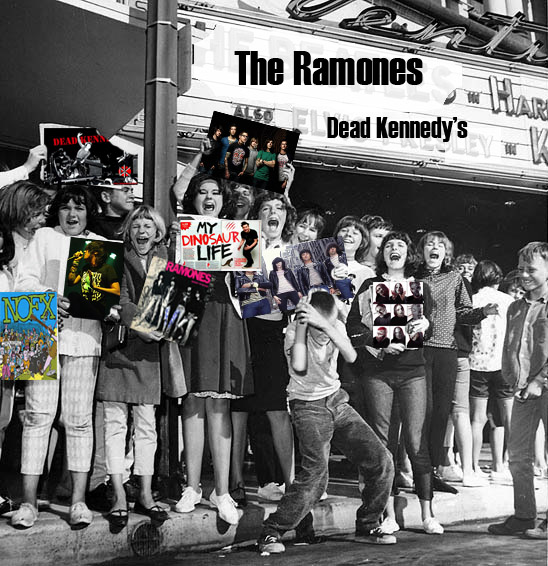
The piece I made is a compilation of several pictures. The
main picture in the background is a group of Beatles fans standing outside one
of their concerts. I wanted to take the fans and replace their love for the
Beatles and change it into bands that are typically considered to be loved only
by drug addicts and hippies. I wanted to point out that these clean cut
individuals could appreciate the music that comes from bands such as the
Ramones, Dead Kennedys, Blink 182, if they would just take the time to look
around the stereotype and listen to the lyrics of the music produced.
I wanted the image to looked very thrown together. I wanted
it to look like things were out of place—because according to society they are.
People who are good and upstanding individuals can’t possibly like NOFX and Bad
Religion? That’s absurd, correct? I feel like there is such a stigma to
metalheads, especially in Provo. This is where the poem comes in. It is something
that I wrote just to get my frustrations out about how many people judge me for
the music I listen to, without even knowing the lyrics, and glorify this pop
music that sounds cheerful but is much more dangerous and threatening to the
LDS standards than screamo. It all comes down to preconceived perceptions,
stereotypes, and societal standards that have been around for years but have no
right or authority to dictate our lives and the interpretations of the events
around us.
Monday, February 25, 2013
Movement Manifesto
Manifesto Statements:
http://www.youtube.com/watch?
Artist Statement:
In our manifesto we really wanted to conceptualize the significance of finding beauty in typical things or actions and depicting them in an interesting or unique way. We were really inspired by the grandeur found in Revolution (Life Cycle of a Drop of Water) by Chris Turner and Plastic Bag by Ramin Bahrani. As the title of each signifies, they are each about something simple and that we associate with every day. But through the creative eyes of these directors we as viewers are given new insight into the life of each of a simple drop of water and an average plastic bag. We, too, wanted to depict something very typical, but in a way that causes viewers to stop and really appreciate the magnificence something taken for granted. Breathing is definitely something that most of us take for granted; in fact it's so common that most of us can probably go all day doing it and not even think about it. In the exposition we have a girl under water drowning herself; withholding the very thing that grants her life: breath. We juxtapose this several times with underexposed clips of people using breath in various forms. This creates a stark contrast between one and the other: the first no longer wishing to breath, the other finding great joy in their use of breathing. Whether it is blowing out candles, catching your breath, or using a cool breath to cool down a drink, breathing is pretty spectacular and certainly under-appreciated. The last two scenes juxtapose a sigh of relief and choosing to come up for air and live. The multiple shots of types of breaths were to signify how whenever we are without air all we can think about is breathing. The scenes also gradually become shorter in length as the film progresses, in a similar way that breathing increases as stress increases. And then, finally, at the end we slow it down as the the sigh of relief is exhaled and the girl takes a much needed breath. Through this we hope that the viewer will view breath with more appreciation and maybe recognize its significance a little more regularly.
- Good art takes the everyday, the typical, and presents it in a thought inducing and inventive way
- Good art explores new approaches to something ordinary.
- Good art creatively blends conventional with experimental.
http://www.youtube.com/watch?
Artist Statement:
In our manifesto we really wanted to conceptualize the significance of finding beauty in typical things or actions and depicting them in an interesting or unique way. We were really inspired by the grandeur found in Revolution (Life Cycle of a Drop of Water) by Chris Turner and Plastic Bag by Ramin Bahrani. As the title of each signifies, they are each about something simple and that we associate with every day. But through the creative eyes of these directors we as viewers are given new insight into the life of each of a simple drop of water and an average plastic bag. We, too, wanted to depict something very typical, but in a way that causes viewers to stop and really appreciate the magnificence something taken for granted. Breathing is definitely something that most of us take for granted; in fact it's so common that most of us can probably go all day doing it and not even think about it. In the exposition we have a girl under water drowning herself; withholding the very thing that grants her life: breath. We juxtapose this several times with underexposed clips of people using breath in various forms. This creates a stark contrast between one and the other: the first no longer wishing to breath, the other finding great joy in their use of breathing. Whether it is blowing out candles, catching your breath, or using a cool breath to cool down a drink, breathing is pretty spectacular and certainly under-appreciated. The last two scenes juxtapose a sigh of relief and choosing to come up for air and live. The multiple shots of types of breaths were to signify how whenever we are without air all we can think about is breathing. The scenes also gradually become shorter in length as the film progresses, in a similar way that breathing increases as stress increases. And then, finally, at the end we slow it down as the the sigh of relief is exhaled and the girl takes a much needed breath. Through this we hope that the viewer will view breath with more appreciation and maybe recognize its significance a little more regularly.
Wednesday, February 13, 2013
Creative Art Piece
http://vimeo.com/59026775
The everyday/factual/scientific/reality looked at through a colorful lens.
The everyday/factual/scientific/reality looked at through a colorful lens.
Monday, February 11, 2013
Historical Story
https://docs.google.com/file/d/0B3j3VZNPVl2HcTV5N3dfQkpCb00/edit?usp=sharing
Artist Statement:
We told the amazing story of William “Buck” Holloway Joyner.
The exact details of the event where not perfectly know. We did know that he
cut an infection out of his leg, killed two guards and stole a plane to fly
back to the American base. We
really wanted to humanize the opposing side (the Japanese) and fight against
this stereotypical way of making them these heartless enemies. That is why we
decided to follow Takeo a little bit in his home life and leave the decision of
Buck’s reuniting with his family up to him. We really wanted some of the hero
characteristics to reside with Takeo and not with Buck. We chose Takeo’s name,
which means strong and good husband, to demonstrate that as well. We wanted
Buck to be as true to his character as possible, and that character was not
perfect. We didn’t want him to be
the stereotypical WWII idealized hero, we wanted him to have flaws (the
drunkenness and the murder of two people) but have a true motivation for the
escape (family). We didn’t want to take the flat “action film” approach to this
story. We rather focus on the difficult and unique relationship that exists
between a POW and the sincerely kind captor he has known for the past 8 months
and the connection they have through fatherhood.
Reading Neufeld’s, “After the Deluge” it
makes you realize the importance of stories and the power they hold in
preserving the past so that it can be told to those in the future. The
individual stories shared in the comic are stories that would have been shared
to few people or left untold if they had not been adapted into some type of
media and shared on the internet. As film makers we are foremost storytellers
and sharing the past is a duty we have to our ancestors and to humanity in
general. In our script we combine these two duties we have by sharing a story
about April’s grandfather and like the stories in Neufeld’s comics we are
preserving and sharing an isolated incident within a great event in our world’s
history (or nation’s history). We also can better connect with April’s
grandfather as well as the people in Louisiana allowing us to be more
sympathetic to those times or that event which helps us learn from or be
further moved by the actions that take place. Storytelling is history and as
film makers we are in a great position to contribute to that.
This video is a video that was randomly found on youtube by
the Joyner clan, and it features Buck Joyner. You first can see him at 1:26 on
the left hand side. He is the shorter gentleman. At 2:36 he is giving a speech and at 2:45 he looks right at
the camera. Buck passed away in May of 2012 and was just recently buried in Arlington
National Cemetery on February 3, 2013. Watching this was inspiration. It’s a
living memory and portrayal of immortality for Buck. Being able to picture him in your mind, his movements and the
way he looks, really helps you along with character development.
Tuesday, February 5, 2013
Genealogical Artifact

I’ve lived in the same house all my life. My parents moved
there a couple months before I was born, and I slept in the same bedroom every
single night until I left for college. There is a lot of good and a lot of bad
accompanied with that house, as there is with life in general. A decorative
negative was the god-awful, moldy, 80’s shag carpet that inhibited our floors
when my family first moved into the house. It was the color of dirty beige and
had shag so deep it covered your ankles. Okay, so that’s a lie but it was
stained all over from the wear and tare of children. When I was about 10 years
old, my parents decided it was time to change the carpet out. I was
surprisingly devastated. I had cried on that crappy shag carpet. I had fought
and laughed and bled my guts out so much that a rug was stapled into the floor
in hopes that no one would accidently see the stain. This carpet was my
childhood and my parents were willing to chuck it out without even noticing
that my brother and I had taken hours to permanently ingrain hot wheel tracks
within it. Much to my joy, however, they replaced the carpet everywhere in the
house BUT the playroom where I spent much of my time. The new carpet was nice.
It was soft and lovely to look at. Pretty soon hard times hit my family and our
new carpet became stained and worn mainly from the secrets it was holding about
the abuse. I grew up, left for college and came home for summer. My mother was
replacing the carpet yet again. I threw a fit. This new carpet was not MY
carpet, as MY carpet was not MY carpet when it was first installed. I quickly
ran to the playroom so that I could lie on the floor and feel the familiar
bumps and stains of the carpet original to the house. It was gone. Mother had
even replaced that room too. My childhood was over. I was never again to be 6
years old crying silent tears because I split apple juice on the carpet, the
carpet and the apple juice stain that no longer had a place in the only house I
called home. My mother sensed my sentimentality and presented me with a shadow
box with three stripes of carpet in it; the 1st strip the original
carpet, the 2nd from when I was 10, and the 3rd a piece
of the new carpet just installed. My mother rolled her eyes remarking my
strange love for the “damn carpet” but it wasn’t the “damn carpet” I cared so
much for. That night I tried sleeping in the brand new double bed that had
replaced the twin I was used to, but couldn’t. I went to lie down on MY carpet,
but it was gone. I stared long and hard at the shadow box and began to sob. I
would never go back to the life I knew with those past carpets. It was over. No
more hot wheels with my brother, no more wrestling matches, no more late night
snacks spilt on the floor, no more yelling, and crying and beatings. I realized
that I didn’t care about the carpet; I cared about the phases of my family that
had stained those pieces of floor covering. The original carpet of my
childhood, aged and worn with cheerio crumbs representing when my family was oh
so young and developing. The carpet from my adolescent and teen years riddled
with tears and blood and true trials of a family. Then the brand new carpet—
beautiful, fresh, and unstained; an opportunity for my family’s future. So
there I was lying on my floor staring at the shadow box full of carpet making
tear stains on the freshly installed soft flooring. Damn new carpet. Mother
will kill me if she sees I’ve already ruined you.
Artist Statement:
I focused on the carpet from my home in Texas. As I came to
write the story I put on some of my favorite music and just really
concentrated. I wanted to get the voice right because it’s just not just an
item we need to do justification to, but to ourselves and the meaning behind
the object. I sat down and just let the story flow out. I didn’t stop or think
I just kept writing and writing wanting to go back and fix any errors or
revisions later. I wanted the story to be as natural as possible but still have
a certain written artistic style that I know I didn’t present when I told it in
front of the class. We were told
to have a certain degree of performance within our text. I struggled with this.
By my final draft of the story I feel like I did accomplish this, but it took a
while to define what I wanted to go for, which was just straight up natural
speak but a fair amount of imagery as well as opening up a little bit about my
family and our relationship struggles throughout the years of growing
together.
The poem from our reading (On page 112) really inspired me
to choose the carpet. It says the lines, “Not only did they touch me, or my
hand touch them: they were so close that they were a part of my being…”. I
really contemplated this while choosing my subject and the carpet stuck out
clearly as something that was more than just an object from my life it was a
part of being that it could have “lived half my life and will die half my
death.”
I am a fan of the classics, so we are gonna kick it old
school and reference The Scarlet Letter.
Just as within the novel, a piece off fabric has so much more symbolism and
metaphorical meaning than it presents. In The
Scarlet Letter it represents Hester’s pain, suffering and societal
judgments on her. She wears her sin, her troubles, and her past. In many ways,
the carpet of my family literally holds all the stains from mishaps and
wrestling matches and fights that mark us as this imperfect family with things
to be judged for. People could look at our carpet and see what we are. That may
be exaggerated to an extreme but I know I would happily cut a piece of the old
carpet and pin it to my clothing if people desired me to represent the sins of
my family in a tangible way. I would wear it proudly to make the point that no
one has a right to judge my family, that they are mine and I am grateful for
the good and the bad choices we have made that have gotten us to where we are,
which is still fundamentally screwed up, but at least still a family. Maybe this carpet, like Hester’s
scarlet letter, is my “passport into regions where other women dared not tread”(Nathaniel
Hawthorne).
Subscribe to:
Posts (Atom)